
Knowledge that drives action
Open-source frameworks, research, and practical guides to support evidence-driven development practice.
Intelligence for
Better decisions
PaaiEcos: The household, made measurable.
AI EcosystemPoverty Assessment Artificial Intelligence Ecosystem. From who is poor to what will move them.
Every measure of poverty in common use answers who is poor. None answers why, how fast, or what would change it. PaaiEcos measures poverty the way a clinician assesses a patient, not the way a census counts a population: 64 indicators across eight domains, scored on five axes — level, intensity, duration, velocity and fragility.
A causal model over the four H.E.A.T pillars identifies the binding constraint rather than the loudest symptom, and ranks interventions by predicted uplift, cost and live availability for that household. The output is not a label — it is a sequenced, costed prescription with a confidence interval, audited against what actually happened.
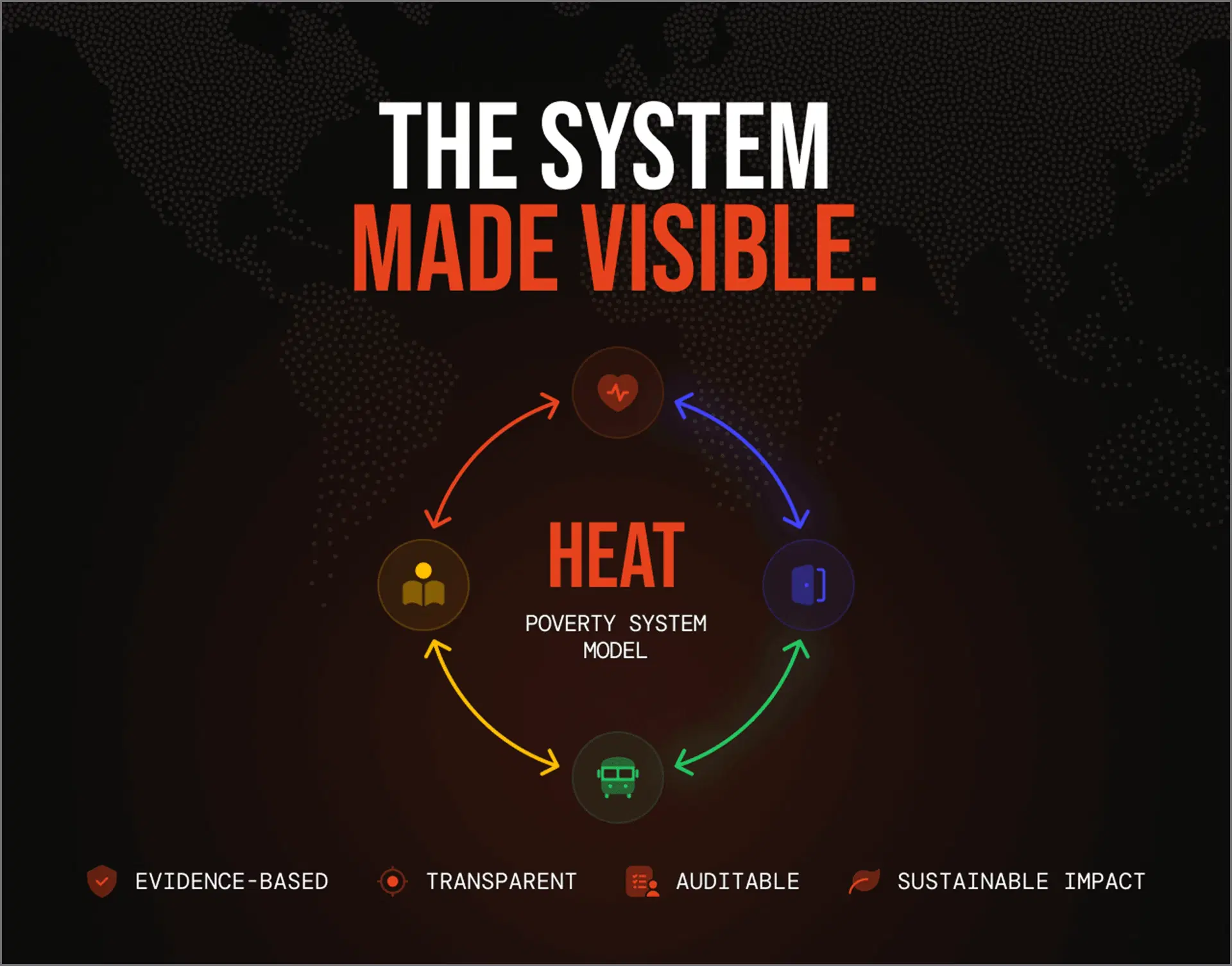
The system, made visible.
FrameworkSee how poverty is connected. Change where it matters most.
HEAT models poverty as a coupled, four-pillar system. Each component is sourced, each dependency mapped, and every intervention auditable. Built from peer-reviewed evidence, it helps decision-makers understand where change can create lasting impact.
By revealing how health, education, access, and transportation interact, HEAT transforms complex development challenges into actionable intelligence for sustainable solutions.
Development that outlives
the project.
A delivery methodology, not a competing agenda. SUSTAIN-Africa converts development investments into locally owned capabilities, systems and economic opportunities that keep creating value after external support ends — because exit is designed at entry.
Pillar 01 of 07
Shared ownership
Genuine community authority over priorities, design, management and the future of the investment — ownership that means more than attending meetings.
- Participatory needs & opportunity assessment
- Community-led priority setting
- Local governance structures
- Ownership & responsibility agreements
- Inclusion of women, youth & marginalised groups
Key question
Who will own this when the project ends?
No pillar is sufficient alone. Ownership without capability stalls; capability without systems decays; systems without economic value are not maintained.
The graduated transfer ladder
Our role is designed to shrink.
- 01
Lead
External organisation leads; the community participates in decisions and delivery.
- 02
Co-lead
Community and external organisation jointly manage the intervention.
- 03
Community-led
Community or local institution leads; the partner provides technical support.
- 04
Independent
Local actors operate independently; support only where strategically necessary.
- 05
Local replication
Local actors train others and replicate the model in neighbouring communities.
The SUSTAIN exit test
Five tests before full exit.
- 1
The Ownership test
Can local actors make decisions about the investment without external permission?
- 2
The Capability test
Can local people perform the critical technical and managerial functions?
- 3
The Systems test
Are maintenance, financing, governance, procurement and monitoring systems functioning?
- 4
The Economic test
Is there enough economic or social value to motivate continued investment and use?
- 5
The Resilience test
Can the system withstand foreseeable shocks and adapt without returning to dependence?
Progress is scored on a 1–5 Readiness Index across all seven pillars, so capacity transfer becomes a measured trajectory a funder can verify — not a narrative claim.
Don't just build the asset. Build the people who can sustain it, the systems that support them, and the economy that makes it possible. Then transfer ownership.
Discuss SUSTAIN-AfricaInterested in
partnering with us?
Whether you represent a government, foundation, university, or international body, we would love to explore how we can work together.